GENHESIS
The project “Tecnologías de electrolizador y pilas de combustible habilitadoras del Hidrógeno Verde como vector energético (GENHESIS)” is led by IDAE in the Incentive Program 4: Basic-fundamental research challenges, innovative pilots and training in key enabling technologies, corresponding to the Incentive Program for the innovative value chain and knowledge of renewable hydrogen within the framework of the Recovery, Transformation and Resilience Plan.
The objective of GENHESIS project is to develop an innovative pilot project (TRL5) for the validation of the applicability of the green hydrogen as an energy vector by combining renewable energy sources (photovoltaic) with an efficient storage of energy surplus using new H2 generating systems (electrolysers) and validate its applicability as an energy vector through fuel cells.This project will be the first validation in outstanding environments at the national level of the enabling technology of complete cycle of green H2 generation and use as an energy vector, achieving costs decrease in all the processes and associated technologies that upgrade its applicability as an energy vector, improving the competitiveness of all stakeholders and with potential replication in numerous productive sectors and in an emerging and expanding sector.
This project will be the first validation in outstanding environments at the national level of the enabling technology of complete cycle of green H2 generation and use as an energy vector, achieving costs decrease in all the processes and associated technologies that upgrade its applicability as an energy vector, improving the competitiveness of all stakeholders and with potential replication in numerous productive sectors and in an emerging and expanding sector.
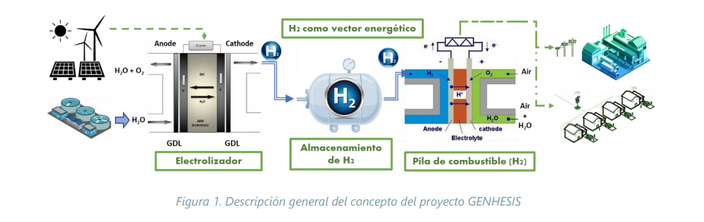
GENHESIS project is focused on industrial research in many different technological areas.
The first one corresponds to a new AEM electrolyser prototype development for green H2 generation and its validation in relevant operating environments with renewable energy sources, particularly photovoltaic energy. The second technological area accords with the fuel cell development to cover the energy demand in reelectrification (power to power) and energy backup applications.
Finally, both technologies will be integrated and validated in real industrial environment with an intermediate H2 storage to ensure the continuous and efficient energy supply from intermittent sources such as renewables. To finish, the new developed systems and technologies are based in the H2 use as sustainable energy vector. The generated emissions will decrease because of the current systems, leading to a drop-off in fiscal charges emanating from the polluting gas emissions. All of this will bring the region and the participating companies closer to the sustainable development objectives and the transition towards a sustainable economy in accordance with the objectives of the European Union, such as the European Green Deal.